Posts

Showing posts with the label WattaBird! INO African LoveBirds

WattaBird! Unlocking the Palette: Breeding African Lovebirds for Mesmerizing Mutations!

Image
WattaBird! Unlocking the Palette: Breeding African Lovebirds for Mesmerizing Mutations! Breeding African Lovebirds to create new mutations can be an exciting and rewarding endeavor for aviculturists. Here are some potential breeding combinations to produce new African Lovebird mutations: Lutino x Lutino: Breeding two lutino African Lovebirds can result in offspring with a higher chance of being lutino, which is a beautiful all-yellow mutation. Lutino x Pied: Crossing a lutino with a pied Lovebird can produce visually striking pied lutinos with patches of yellow and other colors. Turquoise x Blue: Pairing a turquoise Lovebird with a blue one can produce visually appealing turquoise blues, which have a combination of turquoise and blue feathers. Violet x Blue: Breeding a violet Lovebird with a blue Lovebird can result in visually striking violet blues, combining the violet and blue colorations. Opaline x Normal: Crossing an opaline Lovebird with a normal one can produce opaline offspring...
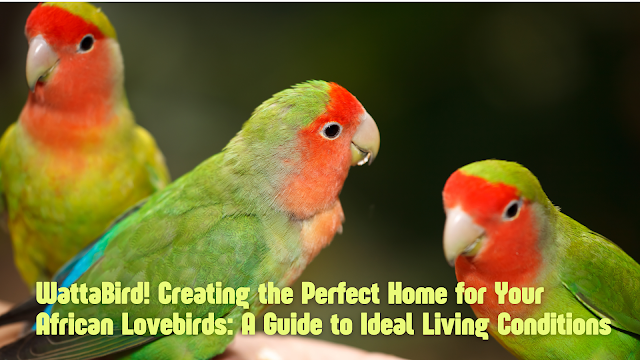
WattaBird! Creating the Perfect Home for Your African Lovebirds: A Guide to Ideal Living Conditions

Image
WattaBird! Creating the Perfect Home for Your African Lovebirds: A Guide to Ideal Living Conditions

WattaBird! Love without Limits: How to Prevent Inbreeding in African Lovebirds

Image
WattaBird! Love without Limits: How to Prevent Inbreeding in African Lovebirds

WattaBird Breeding Chart: INO Mutation in African LoveBirds

Image
WattaBird Breeding Chart: INO Mutation in African LoveBirds    Agapornis Roseicollis This Breeding Chart aims to help provide an idea regarding the breeding combinations for the Ino mutation in African LoveBirds. This Ino Breeding Chart applies to both Albino and Lutino African LoveBird s, and therefore, I will be using the term “Ino” within this article. Albino is the term used to refer to White Ino LoveBirds . Lutino is the term used to refer to Yellow Ino LoveBirds . This Ino Breeding Chart will also provide a bloodline composition of the offspring, which will be useful for matching breeding pairs for a targeted result. The Ino gene is a Sex-Linked trait. This genetic trait is hereditary and can be passed on to the offspring. The Ino inheritance will depend on the INO genes the parents carry. Since the Ino trait is sex-linked , daughters will NEVER be Split-Ino . Daughters can only be either Visual Ino or Normal . Sons on the other hand can be, Visual Ino or Split-I...

WattaBird! Understanding the Peach-Faced LoveBirds Mutations (Part 2 of 3: Sex-Linked Inheritance)

Image
WattaBird! Understanding the Peach-Faced LoveBirds Mutations (Part 2 of 3: Sex-Linked Inheritance) Agapornis Roseicollis This is the Part 2 of 3 of the topic  Understanding the Peach-Faced LoveBirds Mutations.  If you have not read Part 1 of 3 yet, please visit this link:  WattaBird! Understanding the Peach-Faced LoveBirds Mutations (Part 1 of 3: Recessive Inheritance) “If You have any questions, suggestions, or topics to discuss please leave a comment below.” SEX-LINKED INHERITANCE This blog post will discuss the next method or pattern of inheritance which is what is called  SEX-LINKED. SEX-LINKED  inheritance in African LoveBirds are traits that are carried in the genetic chromosomes that also determines the sex of the offspring.  In sex-linked inheritance  daughters  will  NEVER be Split . Daughters  can only be either  Visual  or Normal. Sons  on the other hand can be,  Visual  or  Split . Here is a guid...

WattaBird! Featured Breeder: Malic Aviary

Image
WattaBird! Featured Breeder: Malic Aviary Malic Aviary Cainta, Rizal, Philippines The featured African LoveBirds Breeder for this week is  Malic Aviary  from Cainta, Rizal, Philippines.   Malic Aviary  is breeding Fischer LoveBirds with focus on the Opaline mutations. Check out the Breeding Program shared by Malic Aviary in the later part of this blog. These are some of the offspring from the Malic Aviary Breeding program. This gallery showcases some photos from Malic Aviary. Please enjoy the gallery, starting from the chicks being hatched, and up to some days old. These are some on the Breeding Pairs the Malic Aviary has used for his Breeding Program This is the beauty of Breeding African LoveBirds. You get to plan on what mutations you want and start a breeding pair to produce the mutations you projected. The reward you feel when you are able to produce the mutation you planned, is that of great feeling of fulfillment and accomplishment. These are some o...

WattaBird! Breeding WhiteHood Opaline African LoveBirds (Pair 2)

Image
WattaBird! Breeding WhiteHood Opaline African LoveBirds (Pair 2) The objective of this breeding project is also to produce  WhiteHood Opaline Lovebirds . This is my second breeding pair projected to produce WhiteHood Opaline . For this breeding project, the Cock is a   White-Face Blue Split to Opaline   while the Hen is a   White-Face Ino Split to Fallow . Both parents have White-Face lineage, and the Cock is split to Opaline. These are the common denominators used so we can produce a  WhiteHood Opaline LoveBird . The Cock being split Opaline, while the Hen being Non-Opaline will result in the following projections. Breeder Pair:  Cock:  Split Opaline LoveBird  x Hen:  Non-Opaline LoveBird Projected OffSprings: Opaline Genetics 50% Sons are Split to Opaline 50% Sons are Not Split to Opaline 50% Daugthers are Visual Opaline 50% Daugthers are not Opaline Projected OffSprings: Ino Genetics All Sons are Split to Ino Al...

WattaBird! Orange-Face American Lutino LoveBirds

Image
WattaBird! Orange-Face American Lutino LoveBirds An Orange-Face American Lutino , is a golden yellow lovebird, with  white primaries and rump.  The feet, claws and beak are pink salmon, and the eyes are red. The Ino factor is recessive and sex-linked, which means that it is impossible for female birds to be split for Ino. If a female possesses an Ino factor, it is a Lutino. There are not many combinations involving the American Ino factor that can be recommended.  It is "epistatic" to the majority of the other mutations, which is therefore not visible in combinations. What I have in my aviary is an Orange-Face American Lutino. Orange-Face American Lutino The Orange-Face American Lutino is a golden yellow lovebird. The primaries and rump of an Orange-Face American Lutino are white. Orange-Face American Lutino. The feet, claws and beak are pink salmon, and the eyes are red.